Mission
Overview
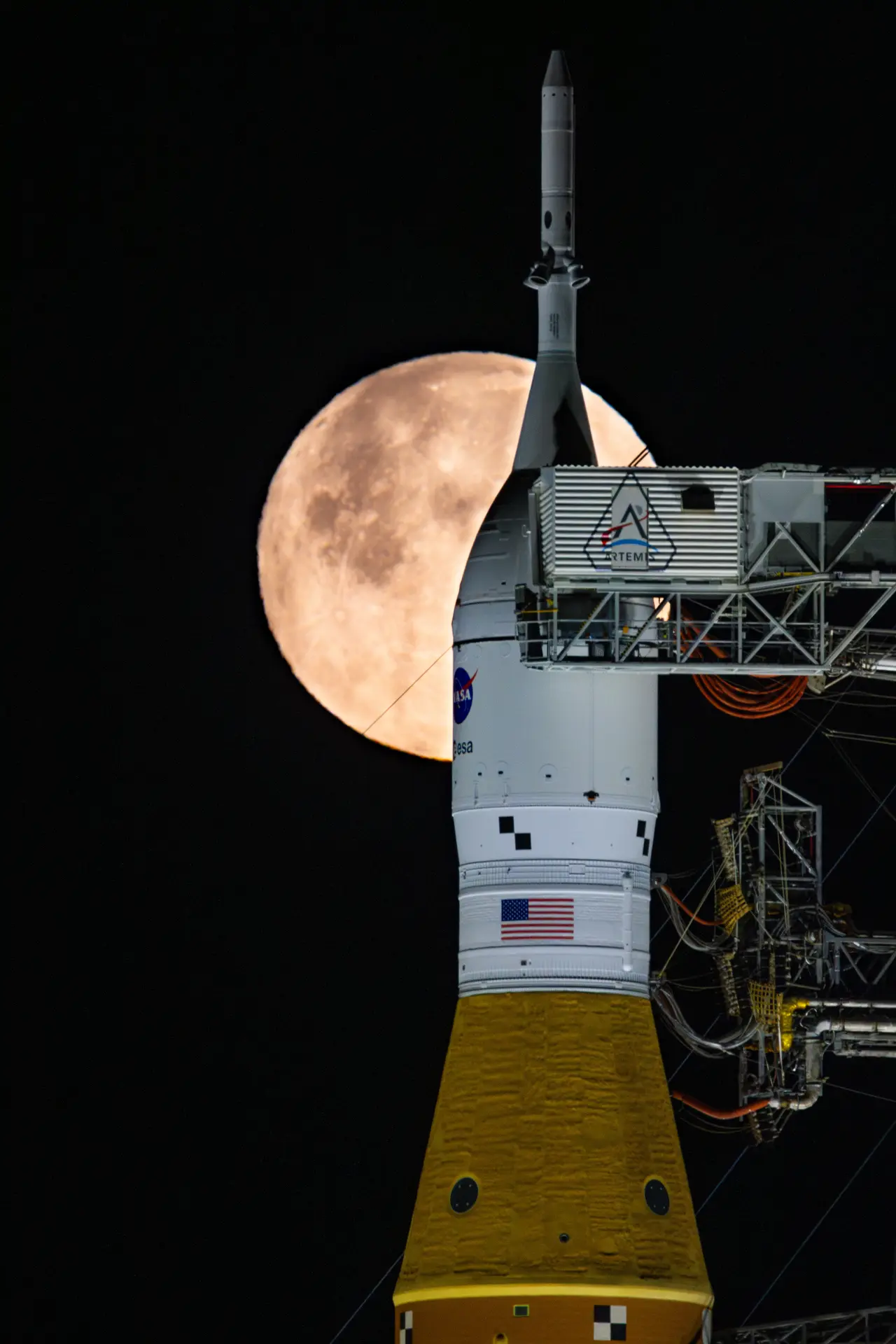
Artemis II was NASA's first crewed mission to the vicinity of the Moon since Apollo 17 in 1972. The mission sent four astronauts around the Moon to test all of Orion's systems with crew aboard in preparation for future lunar landing missions.
The 9-day mission demonstrated Orion's capabilities for deep space flight and validated critical systems required for human exploration beyond low Earth orbit. The crew performed a powered lunar flyby, traveling farther from Earth than any human in history.
Mission Objectives
- Tested Orion spacecraft systems with crew in deep space environment
- Validated life support systems for extended missions beyond low Earth orbit
- Performed powered lunar flyby using Moon's gravity for free-return trajectory
- Demonstrated high-speed reentry from lunar return velocities
- Evaluated crew interfaces and operational procedures for future missions
Mission Timeline
Launch
00:00:00Artemis II launched from Kennedy Space Center Launch Complex 39B aboard the Space Launch System (SLS) Block 1 rocket with the Orion spacecraft.
launchEarth Orbit Insertion
00:08:18Orion reaches initial Earth orbit after separation from the SLS core stage. The spacecraft enters a safe elliptical orbit while systems are checked.
earth-orbitOrion-ICPS Separation
03:24:15After reaching high Earth orbit, Orion separates from the Interim Cryogenic Propulsion Stage (ICPS) and performs proximity operations demonstration, testing manual piloting capabilities.
earth-orbitTranslunar Injection
25:37:00Orion's service module performs the translunar injection burn, propelling the spacecraft toward the Moon and setting it on a free-return trajectory.
outboundOutbound Trajectory Correction #1
48:07:00First of three outbound trajectory correction burns to refine Orion's path toward lunar flyby.
outboundOutbound Trajectory Correction #2
72:12:00Second trajectory correction maneuver ensures Orion stays on target for its lunar flyby.
outboundOutbound Trajectory Correction #3
101:23:00Final outbound trajectory correction burn before entering the lunar sphere of influence.
outboundLunar Flyby Begins
119:45:00Crew begins lunar observation period, passing between 6,400 and 9,700 km (4,000-6,000 miles) above the lunar surface - much higher than the Apollo missions which orbited at approximately 110 km.
lunar-flybyClosest Approach to Moon
121:23:00Orion reaches its closest point to the Moon, flying over the far side and temporarily losing contact with Earth for approximately 30-50 minutes.
lunar-flybyMaximum Distance from Earth
121:26:00Orion reaches its farthest point from Earth at approximately 400,000 km (250,000 miles), traveling farther from Earth than any human has been in over 50 years.
deep-spaceReturn Trajectory Correction #1
148:23:00First of three return trajectory correction burns to ensure safe reentry path to Earth.
returnReturn Trajectory Correction #2
196:33:00Second return trajectory correction maneuver refines Orion's path for splashdown.
returnReturn Trajectory Correction #3
212:33:00Final trajectory correction burn, completed five hours before entry interface.
returnService Module Separation
217:13:00Orion's service module separated from the crew module, exposing the heat shield for reentry. The service module burned up in Earth's atmosphere.
reentryEntry Interface
217:33:00Orion reached entry interface at 400,000 feet (76 miles) altitude, beginning atmospheric entry at approximately 39,688 km/h (24,664 mph) — comparable to Apollo-era lunar return speeds.
reentrySplashdown
217:46:00Orion splashed down in the Pacific Ocean west of Rosarito, Baja California, concluding the 9-day mission and paving the way for future Artemis lunar landings.
recoveryTimeline data sourced from NASA's Artemis II Press Kit
Apollo Records
The Apollo program set numerous records for human spaceflight. Artemis II approached and exceeded several of these historic achievements, marking humanity's return to deep space exploration.
Farthest Distance from Earth
Crew:
James Lovell, Fred Haise, Jack Swigert
Apollo 13 holds the record for the farthest distance humans have traveled from Earth. The mission was aborted after an oxygen tank explosion, and the crew used a free-return trajectory that took them around the far side of the Moon at this record distance.
Artemis II Comparison:
Artemis II reached a peak distance of 406,771 km from Earth on April 6, 2026 — surpassing Apollo 13's record and setting a new all-time human distance record.
Fastest Crewed Reentry Speed
Crew:
Thomas Stafford, John Young, Eugene Cernan
Apollo 10 achieved the highest speed ever attained by a crewed vehicle during its return from the Moon, reaching 39,897 km/h (24,791 mph) relative to Earth during reentry.
Artemis II Comparison:
Artemis II returned at 39,688 km/h during reentry — comparable to Apollo-era lunar return speeds but just below Apollo 10's record. The speed record was not broken.
Last Humans Beyond Low Earth Orbit
Crew:
Eugene Cernan, Harrison Schmitt, Ronald Evans
Apollo 17 was the final Apollo mission and marked the last time humans traveled beyond low Earth orbit. The mission lasted 12 days and included 22 hours of lunar surface exploration.
Artemis II Comparison:
Artemis II became the first crewed mission beyond low Earth orbit since Apollo 17, ending a 54-year gap in deep space human exploration when it launched on April 1, 2026.
First Humans to Orbit the Moon
Crew:
Frank Borman, James Lovell, William Anders
Apollo 8 was the first crewed mission to orbit the Moon, completing 10 orbits. The mission provided the famous 'Earthrise' photograph and proved that humans could travel to and from the Moon safely.
Artemis II Comparison:
Artemis II did not enter lunar orbit — the Orion spacecraft's European Service Module cannot independently depart from low lunar orbit. Instead, the crew performed a powered flyby, using the Moon's gravity for a free-return trajectory, making them the first humans to travel to the Moon's vicinity since Apollo 17 in 1972.
First Humans on the Moon
Crew:
Neil Armstrong, Buzz Aldrin, Michael Collins
Apollo 11 achieved the first successful crewed lunar landing, with Armstrong and Aldrin spending 21.5 hours on the lunar surface and performing one moonwalk lasting 2 hours 31 minutes.
Artemis II Comparison:
Artemis II did not land on the Moon — it was a crewed flight test of the Orion spacecraft and Space Launch System. The first Artemis lunar landing remains planned for Artemis III, which will include the first woman and first person of color on the lunar surface.
Total Missions to the Moon
The Apollo program conducted 9 crewed missions to the Moon between 1968 and 1972 (Apollo 8, 10, 11, 12, 13, 14, 15, 16, 17). Six of these missions successfully landed on the lunar surface.
Artemis II Comparison:
Artemis II served as the first crewed flight of NASA's Artemis program, launching on April 1, 2026 and completing a 9-day mission around the Moon — the beginning of a new era of sustained human deep space exploration.